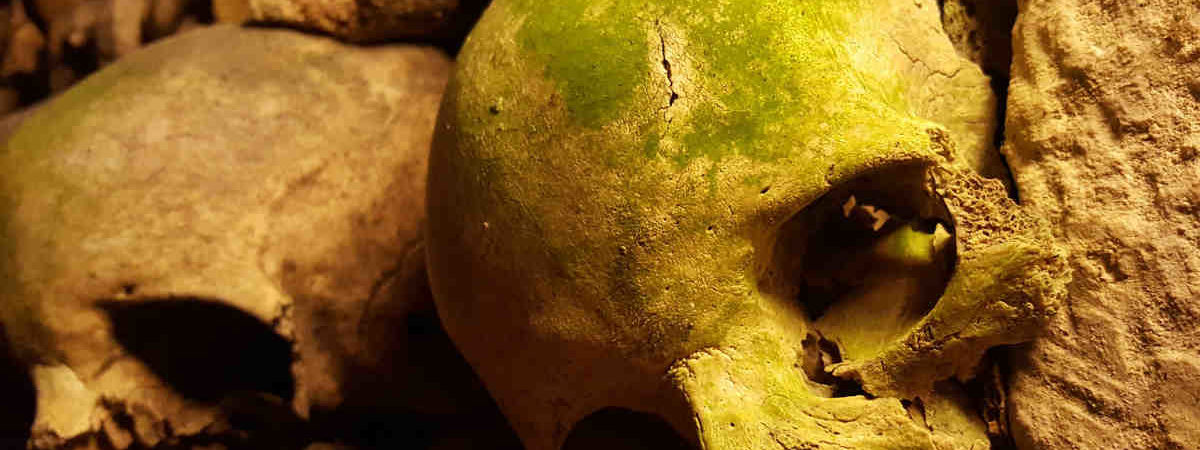
Entering the Empire of Death
Forget, for a moment, the radiant light of the wide Haussmann boulevards, the ceaseless hum of café terraces, and the dizzying frenzy of the surface. Deep beneath the blistering asphalt and the historic cobblestones of the capital lies a silent kingdom, a vertiginous mineral labyrinth where time seems to have permanently suspended its flight. Welcome to the true bowels of the City of Light. Welcome to the legendary Paris Catacombs.
Descending 65 feet deep beneath the Parisian tumult means agreeing to cross the threshold into a twilight subterranean world and embarking on an unparalleled rite of passage. From the very first steps of the spiral staircase, the atmosphere of the modern city vanishes. The air suddenly grows denser, deeply steeped in the centuries-old scent of damp stone and bone dust. The temperature, meanwhile, freezes at an unwavering 57°F (14°C), completely indifferent to the summer heatwaves crushing the surface or the biting winter frosts.
In this sanctuary of silence, disconnected from the cycle of the sun, the largest ossuary in Paris (and the world) silently watches over the eternal rest of more than six million souls. From the remains of anonymous Middle Age citizens struck down by the Black Death or cholera, to the bones of illustrious and tragic figures of the French Revolution (such as Danton, Robespierre, or Lavoisier, whose remains were thrown into the Errancis before being transferred here), it is the intimate, visceral, and organic history of an entire people that lines these limestone walls.
But unlocking the secrets of this fascinating memento mori (the Latin injunction reminding us of our mortality) cannot be improvised. Exploring this subterranean world today requires rigorous planning. This website, “Passion Catacombes,” was designed by underground heritage experts to be your infallible compass. From the strategic acquisition of your skip-the-line tickets to understanding the geological mysteries that support the capital, here is everything you need to know for an unforgettable exploration in 2026.
Ticketing & Reservations: Anticipation is the Only Rule
While the Parisian bones have traversed the centuries with infinite patience, the methods of accessing their sanctuary have radically evolved. In 2026, spontaneity and improvisation absolutely no longer have a place at the gates of the underground. For crucial reasons of public safety, evacuation, and above all, the preventive conservation of this priceless and highly fragile heritage, the daily visitor capacity is drastically and scrupulously limited.
The days when tourists could wait for hours, huddled in front of the physical ticket booths at Place Denfert-Rochereau, are definitively over. Today, access relies on a strictly digital ticketing system. Hoping to get a spot on the day of your visit without any prior preparation is an absolute guarantee of bitter disappointment in front of computerized closed doors. The 2026 prices and time slots are often snatched up weeks in advance, particularly during spring long weekends, holidays, or the unmissable Halloween season, when crowds reach global peaks.
To guarantee a seamless, stress-free underground visit without wasting time, several strategic options have been designed to suit your explorer profile:
- Standard Ticket with Audio Guide: The most classic and essential option. It allows you to roam the dark galleries in total autonomy, at your own pace, accompanied by a highly immersive audio narrative that decodes the history, architecture, and anecdotes of every corner of the ossuary.
- VIP Small Group Guided Tour: The ultimate, privileged experience for true enthusiasts. Accompanied by a certified historian guide, you will leave the standard route to have the gates of sectors strictly closed to the general public unlocked for you. There, you will discover hidden treasures like the fascinating sculptures of the Port-Mahon gallery, carved into the rock by a former soldier, or the famous quarrymen’s footbaths, revealing a secret hagiography of the site.
- Last-Minute Tickets: An unexpected fallback solution for forgetful travelers, often made possible through the flexibility of our certified partner platforms, allowing you to snag time slots canceled by other visitors at the very last second.
👉 [Check Prices & Book Now]
The Explorer’s Practical Guide: Prepare for Your Descent
An incursion into the depths of the Earth requires a minimum of logistical and mental preparation. The Paris Catacombs are not a traditional museum with polished floors; they constitute a raw, authentic mineral environment, with specific physical constraints that must be understood to appreciate the journey.
The monumental adventure begins at 1 Avenue du Colonel Henri Rol-Tanguy, exactly at Place Denfert-Rochereau (easily accessible via Paris Metro lines 4 and 6, or by RER B). As soon as your digital pass is validated, the physical trial begins: you must descend a vertiginous spiral staircase made of 131 stone steps to reach the very bottom of the city. It is at this precise moment that the transition occurs.
The marked route covers a loop of around 1 mile and takes on average between 45 minutes and 1 hour, depending on the time you dedicate to contemplating the facades of bone. While the galleries are perfectly secured, ventilated, and cleverly illuminated by modern scenography, the ground itself remains authentic: it can be slippery, uneven, and sometimes dotted with small puddles of seepage water. Immediately forget fragile city shoes or heels; it is imperative to opt for comfortable sneakers or light hiking shoes capable of withstanding the dampness of the ancient quarries.
Above all, never let yourself be fooled by the glaring sun or the stifling heat that might reign on the surface. At 65 feet below the tarmac, the thermometer is stuck: it never exceeds 57°F (14°C). Therefore, systematically remember to pack a cardigan, a sweater, or a light jacket in your backpack, even in the middle of August, so you don’t spend your visit shivering amidst the piled skulls. Finally, keep in mind that this journey to the center of the Earth is not a one-way trip: the route ends with an inevitable climb of 112 steps, bringing you back to the light of day on Rue Rémy Dumoncel, a few hundred yards from your starting point.
👉 [Expert Guide: Prepare Your Visit]
2,000 Years of History Beneath Your Feet: From Quarries to the Ossuary
To feel the true emotional and intellectual power of this extraordinary place, it is imperative to go back in time. Long before welcoming the remains of Parisians, these dark subterranean passages housed the raw material that gave birth to the city itself: the famous Lutetian limestone. For centuries, since the Gallo-Roman era, obscure and courageous quarrymen dug these galleries using only the strength of their arms to extract this pale, hard, and resistant stone, which was used to build the architectural jewels of the surface: Notre-Dame Cathedral, the Louvre Palace, and later, the majestic facades of Haussmann buildings. Paris is, quite literally, a city born from its own bowels.
History shifts dramatically at the end of the 18th century. Paris, a metropolis experiencing a massive demographic explosion, was literally suffocating under the weight of its dead. The sprawling Cemetery of the Innocents, located in the heart of the bustling Les Halles district, was overflowing uncontrollably. The earth, saturated with corpses after ten centuries of intensive burials, could no longer decompose the flesh. The groundwater was infected, and the air became so pestilential that it turned milk and wine sour in neighboring cellars. Faced with this apocalyptic health crisis, the State Council ordered the suppression of the cemetery in 1785 and the transfer of the bones to the consolidated ancient quarries of Tombe-Issoire.
Thus began nocturnal processions of titanic proportions. Funeral wagons, heavily draped in black veils and escorted by priests chanting the Office of the Dead by the flickering light of torches, poured millions of human remains into the service shafts of the quarries for months.
However, the Catacombs as we wander through them with fascination today owe their romantic and singular aesthetic to a single man: the Inspector General of Quarries, Louis-Étienne Héricart de Thury. In the early 19th century, this man of science and letters categorically refused to leave this place in the state of a simple, vulgar mass grave. Driven by a spectacularly avant-garde museographic vision, he ordered the meticulous arrangement, bone by bone, skull by skull, of this immense chaos. He created majestic geometric walls composed of tibias and femurs, punctuated by alignments of skulls forming mortuary friezes. He then scattered the route with steles engraved with philosophical and poetic quotes, inviting the visitor to profound meditation on the vanity of existence. Through his genius, he transformed the gruesome into a solemn masterpiece.
👉 [Uncover the Secret History]
Paris Necropolis: The Ecosystem of Mystery
The editorial ambition of “Passion Catacombes” reaches far beyond the strict boundaries of the official ossuary route. Our broader vision encompasses the “Paris Necropolis” in its entirety: a fascinating urban and historical ecosystem where death, art, geology, and collective memory are intimately intertwined.
Visiting the official galleries is very often just the very first step of a much broader initiation into the buried mysteries of the capital. Indeed, just a few minutes’ walk from the Catacombs’ exit lies the majestic tranquility of the great Montparnasse Cemetery. There, on the surface, bathed in daylight, the architectural and philosophical contrast is striking. The terrifying anonymity of millions of indistinct underground bones is answered by the individual, illustrious, and finely sculpted tombs of the world’s great minds. Artists and thinkers such as Serge Gainsbourg, Charles Baudelaire, or the famous couple Jean-Paul Sartre and Simone de Beauvoir rest there. Visiting this cemetery is the natural, artistic, and luminous continuation of your subterranean reflection on the passage of time.
But the ecosystem of mysterious Paris is also a sprawling, secret, and illegal network of over 186 miles (300 kilometers) of undeveloped ancient quarry galleries. This is the shadow kingdom of the cataphiles, these urban exploration enthusiasts who, equipped with headlamps and waders, perpetuate a fascinating underground culture, complete with its own codes, its own cartography, and its own legends, far removed from the authorized and marked tourist route. On Passion Catacombes, we rigorously decode the myths, fantasies, and raw realities of this urban subculture, unique in the world.
👉 [Explore the Paris Necropolis]
About Passion Catacombes: Expertise in Service of Heritage
“Passion Catacombes” is not meant to be just another cold, algorithmic, and impersonal tourist directory. It is a grand project matured by visceral enthusiasts of the capital, historians at heart, tourism marketing buffs, and experts in exploring built heritage. Our DNA is clear and uncompromising: to provide you with the freshest, most precise, and most comprehensive information possible to prepare for your visit in 2026.
We closely scrutinize and analyze in real-time the slightest evolutions in ticketing policies, renovation and vault consolidation work, as well as the best on-the-ground tips so that your experience is absolutely seamless. But our ambition goes far beyond simple—albeit essential—logistical advice.
We aim to build a true, united community of aficionados of mysterious Paris and the architecture of the shadows. Through the regular publication of optimized feature articles, the sharing of rare and restored photographic archives, forgotten historical anecdotes, and very soon, the launch of an exclusive, high-quality merchandising line (clothing and accessories with a dark, elegant, and mystical design, directly inspired by limestone engravings and ossuary symbols), Passion Catacombes establishes itself as your ultimate hub.
Join us in this perpetual descent into knowledge. Read our guides, meticulously prepare your arrival, and above all, never forget that beneath your hurried city steps, a completely different heart of Paris beats in silence.