Forget for a moment the honking horns, crowded terraces, and bright lights flooding the Haussmann boulevards. Leave behind the frenzy of the modern world and prepare for a dizzying plunge into the bowels of the capital. Twenty meters beneath the Parisian pavement, the city’s noise fades away, replaced by an absolute silence broken only by the slow seeping of water onto rock. Underground, the air is humid, the light fades, and the temperature remains cool all year round. In this mineral half-light, the bones of six million Parisians seem to be waiting for you.
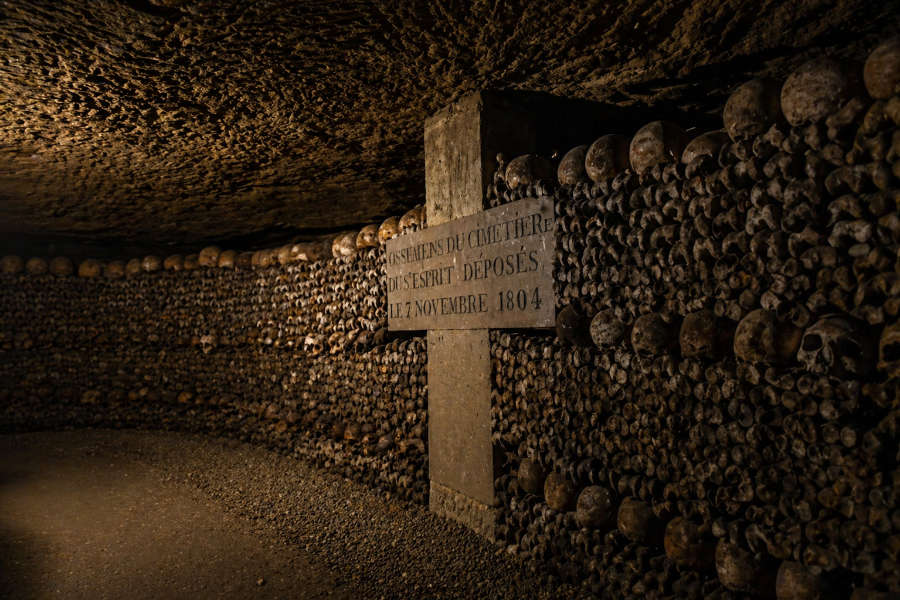
But what exactly are the Catacombs? Far from being mere natural caves, this fascinating maze is actually a massive ossuary built in the heart of the city’s ancient underground quarries.
It is the crossroads where geology, architecture, and death meet. To understand how the remains of millions of individuals – from the plague-stricken of the Middle Ages to the victims of the Revolution – ended up piled beneath our feet, we must turn back time and unravel one of the darkest and most fascinating histories in France.
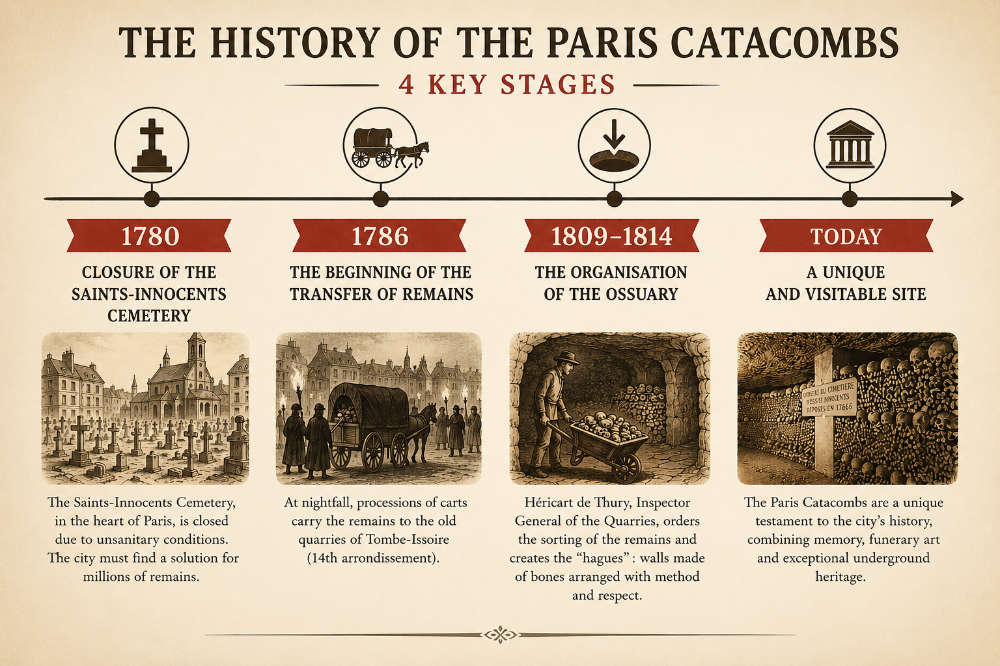
The Genesis: The Lutetian Limestone Quarries
The history of the Catacombs is inherently tied to the very birth of Paris. It is often forgotten, but the City of Light was literally built using stone extracted from its own subsoil.
As early as the Roman Empire, the builders of Lutetia recognized the exceptional quality of the rock sleeping beneath their feet: Lutetian limestone. This blonde stone, both soft to carve and extremely durable once exposed to the air, became the builders’ material of choice. The first extractions were done in open-air pits along the Bièvre valley.
However, with the demographic and architectural boom of the Middle Ages, the need for stone skyrocketed. To build the Louvre Palace, Notre-Dame Cathedral, abbeys, and city walls, quarrymen had to dig deeper and deeper. They went underground, creating a sprawling network of subterranean galleries stretching beneath the present-day 5th, 6th, 12th, 13th, 14th, 15th, and 16th arrondissements.
For centuries, generations of workers extracted stone by the light of fragile candles, supporting the ceilings with turned pillars (carved directly from the mass). Without knowing it, these shadow workers were carving out a massive void beneath the capital, shaping the quarries of Paris that, much later, would host the largest gathering of the dead in the world.
The Cemetery Crisis of the 18th Century
Let’s fast-forward in time. We are in the second half of the 18th century, and Paris is suffocating. The city has nearly 600,000 inhabitants, and death is a daily industry. The heart of the problem lies on the Right Bank, in the bustling commercial center of the Halles district: the dreaded Cemetery of the Innocents (Cimetière des Innocents).
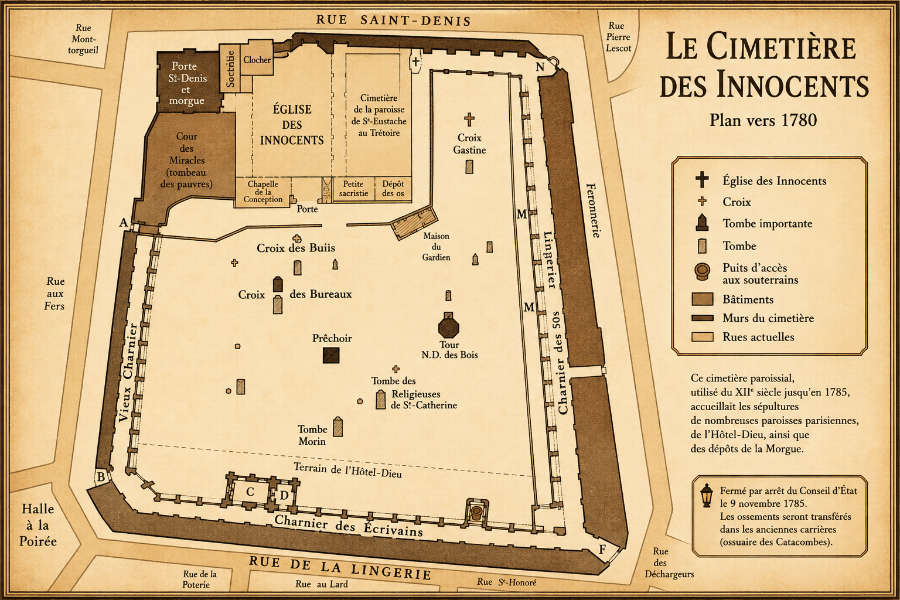
For nearly ten centuries, this parish cemetery received the remains of dozens of Parisian parishes, the Hôtel-Dieu hospital, and the morgue. It is estimated that over two million bodies were buried there. The soil, saturated with organic matter, literally could no longer decompose the corpses. The cemetery ground had risen more than two meters above the adjacent streets due to the accumulation of mass graves, where up to 1,500 bodies wrapped in simple shrouds were piled together.
The sanitary conditions became apocalyptic. Putrid smells plagued the entire neighborhood, turning wine and milk sour in nearby cellars. Doctors of the era denounced the deadly “miasmas” escaping from the soil and spreading epidemics.
The triggering event, the one that would change history, occurred in the spring of 1780. Under the immense pressure of the corpse-gorged earth and heavy rains, the retaining wall of a mass grave suddenly collapsed. Dozens of decaying corpses spilled directly into the cellar of a restaurant owner on Rue de la Lingerie. That was the last straw.
Faced with public outrage and sanitary panic, the State Council issued a decree on November 9, 1785: it ordered the closure and total evacuation of the Cemetery of the Innocents, as well as the gradual closure of other parish cemeteries within the city walls.
👉 Do you want to discover these historic walls with your own eyes?
The Transfer of Remains (1785 – 1814)
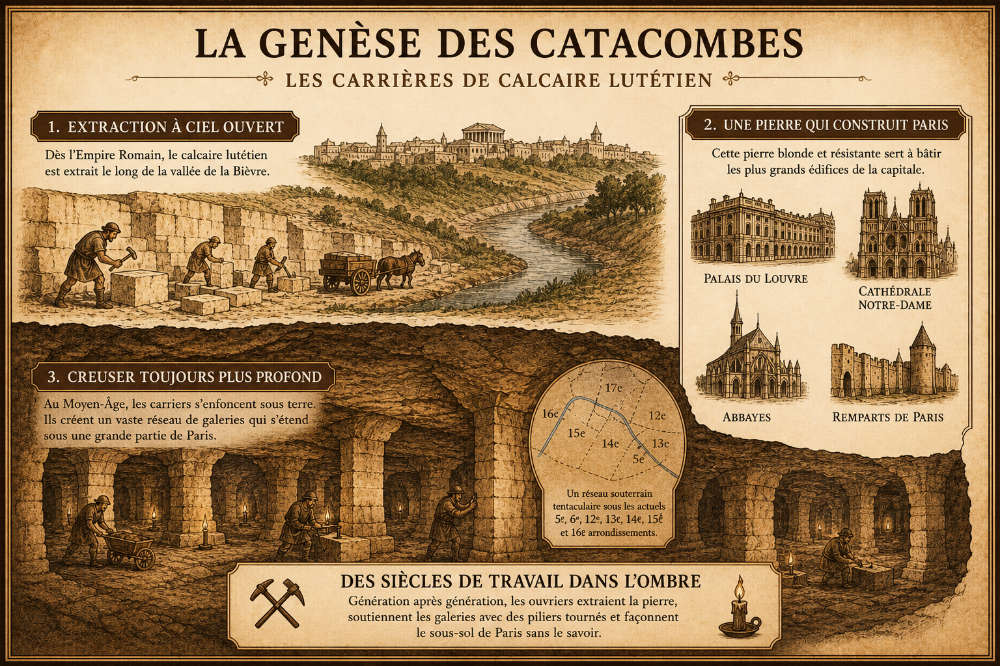
An unprecedented logistical question then faced the Lieutenant General of Police, Thiroux de Crosne: what to do with these millions of bones? The solution lay beneath the area known as Tombe-Issoire (the current 14th arrondissement). There, the General Inspectorate of Quarries, recently created by King Louis XVI to consolidate the collapsing Parisian subsoil, had just secured vast underground spaces. It was decided: the ancient quarries would become the new municipal ossuary.
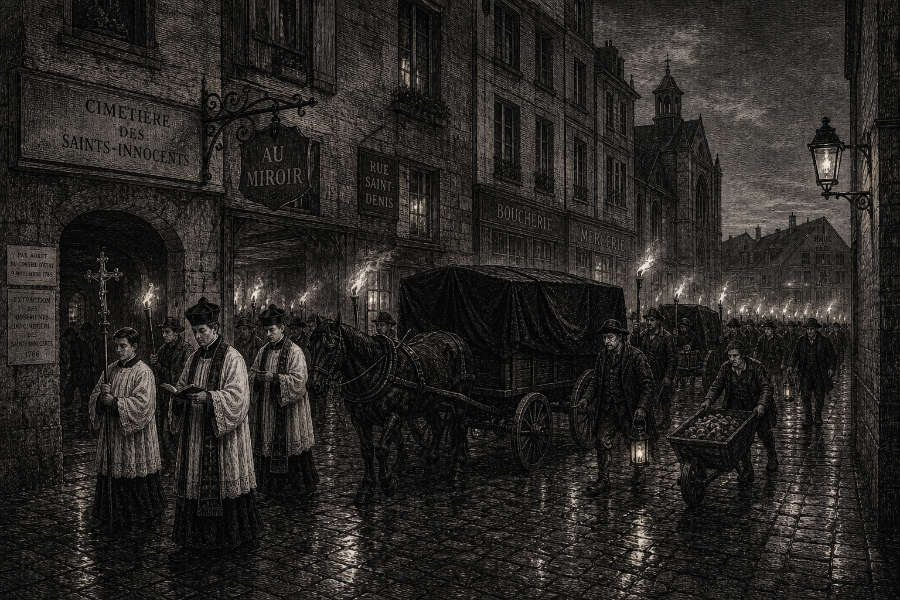
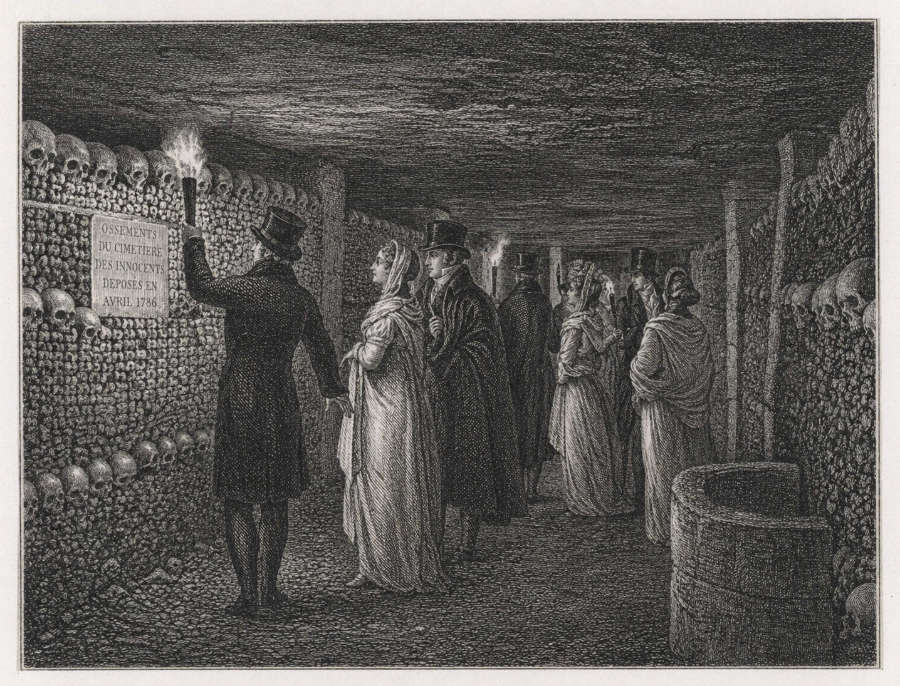
On April 7, 1786, the ossuary was officially consecrated by church dignitaries. This marked the beginning of the largest funerary relocation in history.
To avoid sparking a revolt or offending the sensibilities of the population (and the clergy, who were reluctant to see bodies leave consecrated ground), the transfers took place exclusively at nightfall. Imagine walking through these galleries by the light of a lantern, your mind still haunted by the tales of the time: on the surface, at dusk, somber processions set off. Carts heavily laden with bones, entirely covered in large black veils, crossed Paris to the slow pace of horses. They were escorted by priests in surplices chanting the Office of the Dead, flanked by torchbearers whose flickering flames cast dancing shadows on the building facades.
Upon reaching the quarry service shafts, the bones were thrown into the void, piling up with a mournful crash twenty meters below, before being distributed into the galleries by workers using wheelbarrows. The transfers from the Cemetery of the Innocents were completed in 1788, but the process continued for other Parisian cemeteries until 1814, eventually including the victims of the French Revolution massacres.
From Piles to Staging: The Work of Héricart de Thury
If you visit the Catacombs today, you won’t see vulgar piles of bones thrown together haphazardly. We owe this solemn and terrifying aesthetic to a visionary man: Louis-Étienne Héricart de Thury.

Portrait of Louis-Etienne Héricart de Thury, mining engineer, politician, and scientist.
No machine-readable author provided. Edgard~commonswiki assumed (based on copyright claims)., Public domain, via Wikimedia Commons

Appointed Inspector General of Quarries in 1809, this nobleman, scientist, and humanist was deeply shocked by the chaotic and disrespectful appearance of the ossuary. For him, this place of death should not be a mere dumping ground, but a worthy mausoleum, a monument to the memory of Parisians. He decided to transform the ossuary into a visitable museographic and philosophical journey.
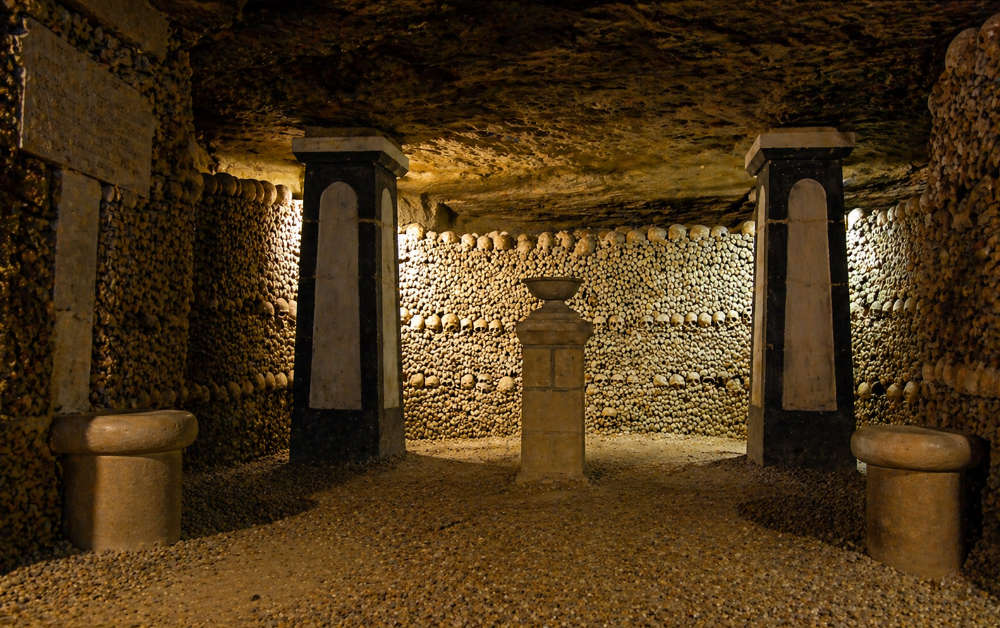
Héricart de Thury ordered his workers to undertake a mammoth task. He had the bones sorted and invented the “hagues”: clever retaining walls made of femurs and tibias stacked with mathematical precision.
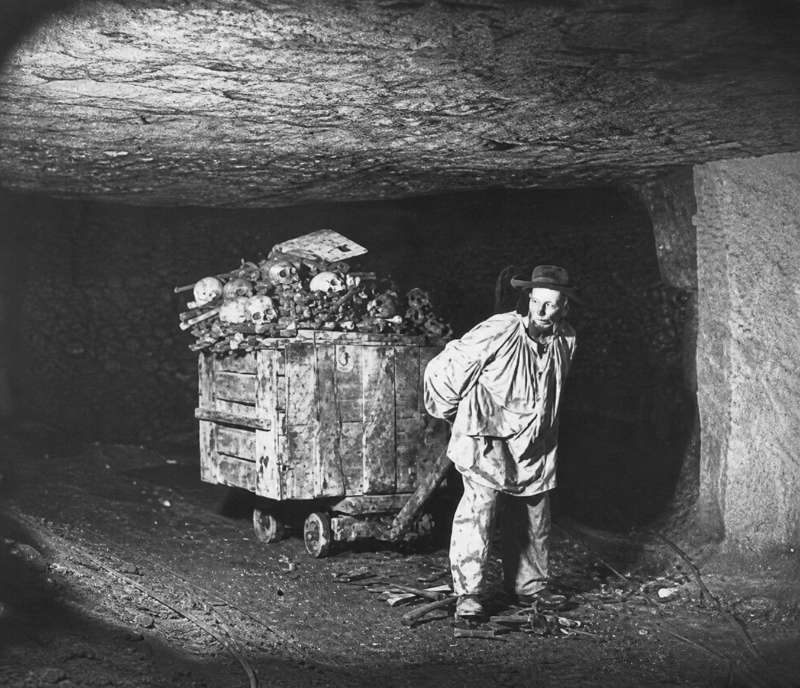
On these bone facades, he had geometric patterns, crosses, or hearts drawn using skulls. Behind these decorative walls (which can be up to 2 meters thick), the rest of the bones (ribs, pelvises, vertebrae) were thrown in loose, forming what is known as the “remblai” (fill).
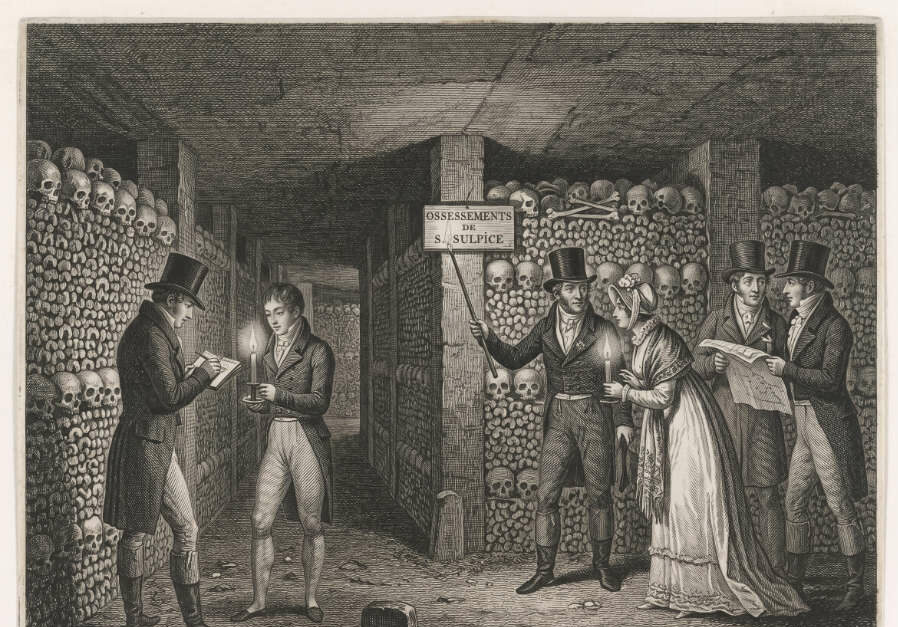
To guide the visitor, he installed commemorative steles and plaques indicating the exact origin of the remains (for example: “Bones from the Cemetery of the Innocents”).
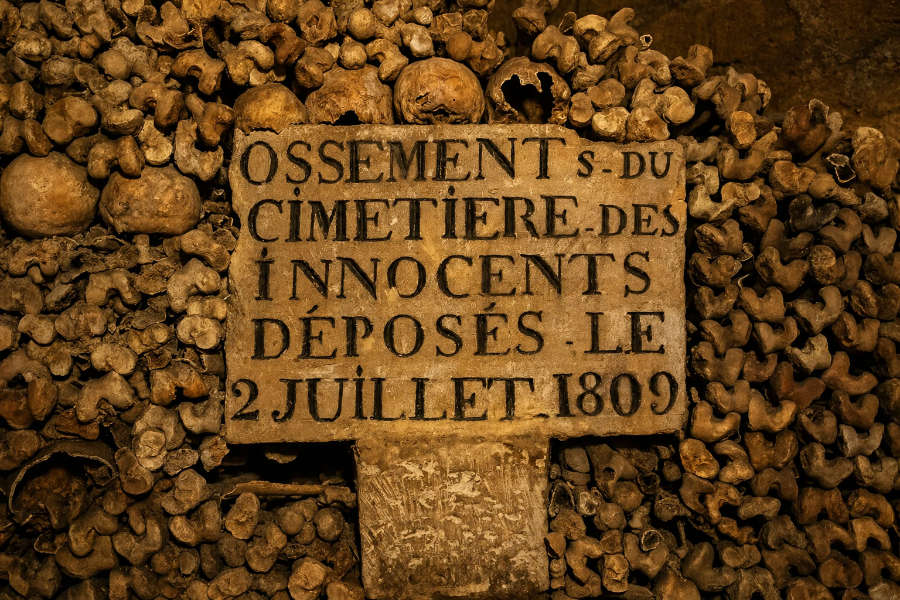
Above all, to give the place its spiritual dimension, he had moral sentences, poems, and excerpts from sacred or secular texts (from Virgil to Rousseau) engraved in stone. These inscriptions constantly remind the living of the vanity of existence. The most famous one welcomes you at the entrance of the ossuary: “Stop! This is the Empire of Death”.
Under his leadership, the Catacombs became an international curiosity. As early as 1809, select visitors, equipped with candles, were authorized to roam this macabre maze, thus pioneering underground tourism.
Myths, Legends, and Unusual Anecdotes
A place so steeped in history and mystery was bound to give rise to numerous urban legends. The darkness of the Catacombs has always fueled fantasies.
One of the most famous and tragic stories is that of Philibert Aspairt.
A porter at the Val-de-Grâce convent, he ventured alone into the quarry network in November 1793, probably through an access point in the convent’s cellars, armed with a single candle and supposedly searching for old bottles of Chartreuse liqueur. He got lost in the pitch-black labyrinth. His body was not found until eleven years later, in 1804, identified by the key ring hanging from his belt. He was buried on the spot, and an isolated stele still marks the exact location of his death today, just a few steps off the official route.
The underground has also been the scene of unusual social events. The most incredible was undoubtedly the clandestine concert of April 2, 1897. That night, a hundred Parisian bourgeois and scholars, secretly invited, gathered in the heart of the ossuary. Conducted by musicians from the Paris Opera, they listened to Chopin’s Funeral March and Saint-Saëns’ Danse Macabre, played among the skulls by the light of torches.
Even today, far beyond the small 1.5-kilometer section laid out for tourism, stretch nearly 300 kilometers of galleries strictly closed to the public. This vast unofficial network is the playground of the cataphiles, passionate underground urban explorers. Despite patrols by the specialized police brigade (the “cataflics”), these clandestine explorers continue to roam the darkness, organize parties, sculpt the stone, and sustain a true counter-culture in the belly of Paris.
Moreover, it is not uncommon to hear rumors of haunted spots. Some visitors or explorers swear they have heard whispers, the sound of ghostly carts, or felt unexplained drops in temperature. Whether you believe it or not, the weight of six million souls is undeniably felt in the oppressive silence of the galleries.
👉 Ready to walk in the footsteps of Philibert Aspairt and the quarrymen of the Revolution?
The Catacombs Today: A Fragile Sanctuary
Having become one of the capital’s most visited monuments with over 500,000 curious visitors a year, the Paris Catacombs are a jewel of Parisian heritage on a global scale. However, this success poses a constant threat to the site.
Managing this environment is a daily challenge for the Paris Musées institution. The site is extremely fragile. The natural humidity, combined with the breathing of thousands of visitors, creates a microclimate that attacks the stone. The artificial lighting, necessary for the visit, promotes the appearance of “green malady”: micro-algae that grow on the bones and limestone.
This is why conservation is now the absolute priority. Access is drastically limited (a strict maximum capacity of 200 people simultaneously) to regulate CO2 and humidity levels. Meticulous restoration campaigns are regularly conducted by consolidators to rebuild bone walls threatening to collapse and to secure the galleries’ ceilings.
The Catacombs are not an attraction like any other. It is a sanctuary, a gigantic necropolis that demands the utmost respect. The rules are strict: it is strictly forbidden to touch the bones, use a flash, or take away the slightest fragment, under penalty of profanation.
To conclude…
Going down into the Paris Catacombs is embarking on a journey through the layers of time. From the Gallo-Roman quarrymen who carved the stone with the sweat of their brow, to the priests of the Revolution escorting the funeral carts in the dead of night, every gallery, every skull, every engraved stele tells a fragment of the Parisian epic. It is not just a sightseeing tour; it is an introspection, an intimate encounter with the city’s collective memory. The silence that reigns there is the most beautiful tribute to these six million anonymous souls who support, for eternity, the foundations of the City of Light. The Empire of Death opens its doors to you… dare you cross the threshold?