Paris Catacombs: Essential Visitor Information
Paris Catacombs Opening Hours Overview
| Day | Status | Opening | Last entry | Closing |
|---|---|---|---|---|
| Monday | Closed | — | — | — |
| Tuesday | Open | 9:45 AM | 7:30 PM | 8:30 PM |
| Wednesday | Open | 9:45 AM | 7:30 PM | 8:30 PM |
| Thursday | Open | 9:45 AM | 7:30 PM | 8:30 PM |
| Friday | Open | 9:45 AM | 7:30 PM | 8:30 PM |
| Saturday | Open | 9:45 AM | 7:30 PM | 8:30 PM |
| Sunday | Open | 9:45 AM | 7:30 PM | 8:30 PM |
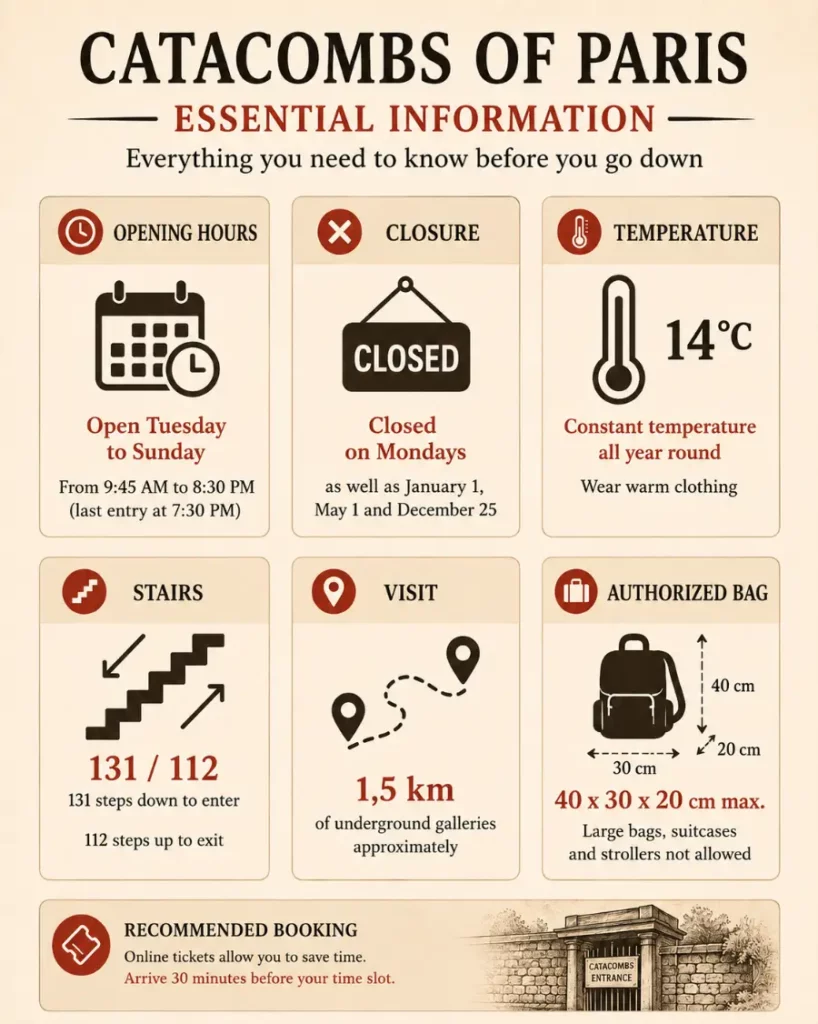
Closed on Mondays, as well as January 1st, May 1st, and December 25th. The Catacombs remain open on most public holidays, unless they fall on a Monday.
Tuesday to Sunday from 9:45 AM to 8:30 PM, last entry at 7:30 PM.
The descent into the quarries is a precision operation, governed by strict schedules to ensure both public safety and the preservation of this fragile heritage. Rigorous planning is the first pillar of a successful visit.
Not sure which day or time to choose? Read our best time to visit guide.
Expert Tip: Avoid the Crowds
Visitor capacity is strictly limited to 200 people at a time underground, which guarantees a mysterious atmosphere and prevents congestion in the narrow corridors. To enjoy almost absolute silence, we highly recommend aiming for the very first morning slots or, conversely, late afternoon slots (after 6:00 PM), especially on weekdays. During weekends and school holidays (particularly the Halloween season), attendance skyrockets; advance booking is your only lifeline.
👉 Compare tickets and timed-entry tours
Is your preferred date sold out? Check our last-minute ticket options. For a more detailed guided experience, compare special-access tours and check which rooms each offer includes.
Powered by GetYourGuide
Access and Transportation: How to Reach the Catacombs
Official Address: 📍 1, Avenue du Colonel Henri Rol-Tanguy, 75014 Paris. (Located on Place Denfert-Rochereau).
Auguste Bartholdi’s work: the entrance to the Catacombs is just a few steps away.
Getting there by public transport
Place Denfert-Rochereau is a major transport hub and is very well served. To get there:
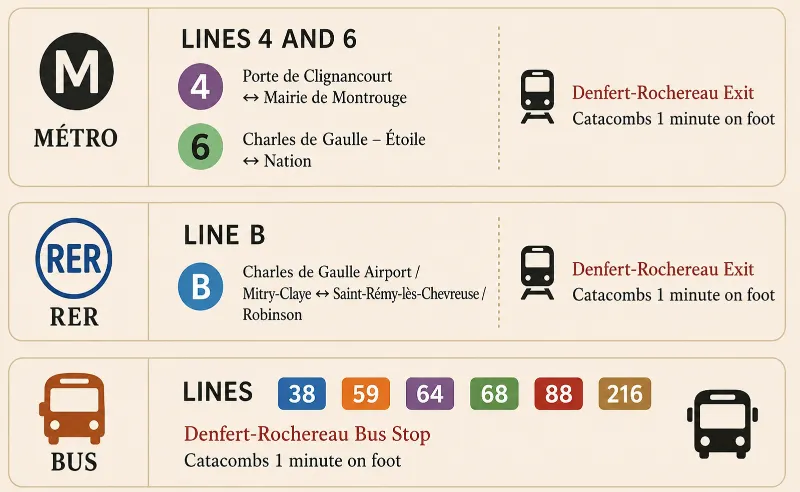
Metro: Lines 4 and 6. Denfert-Rochereau station drops you literally about 50 metres from the entrance.
RER: Line B, Denfert-Rochereau station. Ideal if you are coming directly from the airports — Charles de Gaulle Airport or Orly via the Orlybus — or from central Paris, especially Châtelet–Les Halles.
Bus: Lines 38, 59, 64, 68, 88 and 216.
The Parking Challenge — Coming by Car
We do not recommend trying to park in the surrounding streets. Outdoor parking in this area is scarce, expensive and time-limited. If you have no choice but to come by car, head directly to one of the secure underground car parks:
Indigo Paris Alésia car park — about 10–12 minutes on foot.
📍 See on Google Maps.
Indigo Paris Montparnasse Raspail car park — about 15 minutes on foot.
📍 See on Google Maps.
Important note: Always allow a safety margin of at least 20 minutes for your journey. You must arrive at the entrance exactly at the time shown on your ticket. A significant delay may result in access being strictly refused, in order to avoid disrupting the visitor capacity limits.
Visiting Conditions: The Explorer’s “Dress Code”
You are about to descend into former stone quarries. This underground environment has its own physical and thermal conditions.
The Temperature Trap: The Constant 14°C / 57°F
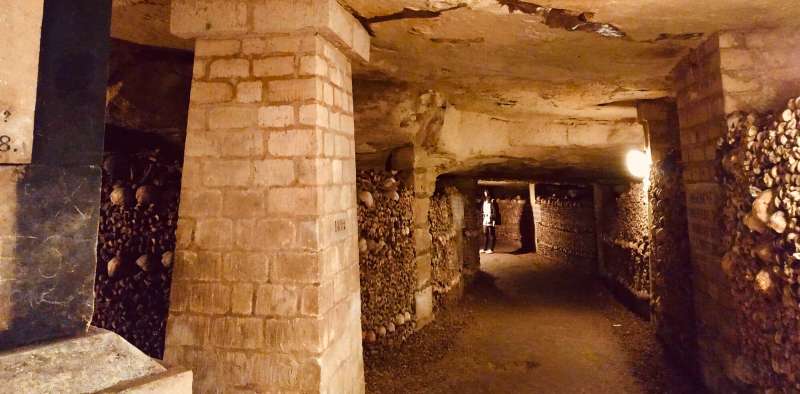
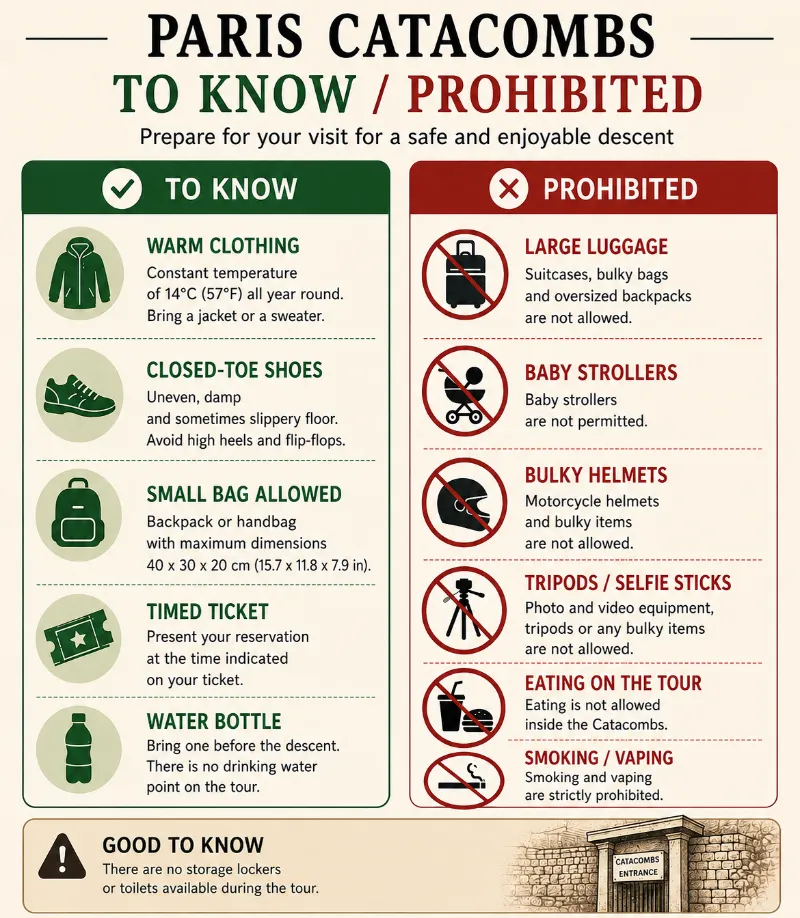
The most common mistake tourists make in the middle of summer is arriving in a tank top and shorts. Twenty metres underground, insulated by thick layers of rock, the ossuary benefits from the Earth’s thermal inertia. The result? The temperature remains a constant 14°C / 57°F, summer and winter alike, with a particularly high level of humidity.
Even if Paris is sweltering in a 35°C / 95°F heatwave in August, you will feel the cold setting in as soon as you reach the lower part of the descent. A sweater, cardigan or light jacket is an essential part of your visit kit.
The Floor Challenge: A 1.5 km Underground Route
The visit follows a route of around 1.5 kilometres. The ground under your feet is nothing like the polished marble floor of a palace. You will be walking on an authentic quarry surface, made of compacted earth and stone. In places, it can be very slippery due to the natural humidity of the underground galleries, with occasional small puddles caused by water infiltration.
Comfortable, closed-toe shoes are strongly recommended. Avoid stilettos — dangerous on the spiral staircases — as well as flip-flops or delicate leather shoes, unless you want to make your underground odyssey unnecessarily uncomfortable.
Security and Bags: The Point to Anticipate
As part of the security checks, the Catacombs apply strict rules on bags and luggage. Avoid large bags, suitcases and bulky items: they may prevent you from entering.
Regulated Bag Dimensions
The galleries are narrow in places, as are the service shafts and staircases. To prevent accidental damage to the walls of bones and to keep visitor movement fluid in case of evacuation, only cabin-size bags or small backpacks are tolerated, with maximum dimensions of 40 x 30 x 20 cm.
Any bag exceeding this size, as well as all suitcases — even small ones — strollers or bulky motorcycle helmets, may lead security staff to refuse you entry. To protect the skulls and bones from accidental contact, visitors are also required to carry small backpacks in front of them, against the chest, or by hand throughout the route.
The Luggage Storage Trap: There Isn’t Any
This is the major logistical point to understand: there are no cloakrooms and no luggage lockers at the Catacombs.
The reason is purely geographical. The route is not a loop bringing you back to your starting point. You enter at Place Denfert-Rochereau, but you return to street level several hundred metres away, at 21 bis Avenue René-Coty, 75014 Paris. It is therefore physically impossible for the site to return your belongings at the end of the visit.
If you are passing through Paris with luggage, use the automatic lockers at major train stations — such as nearby Gare Montparnasse — before going to the Catacombs entrance.
Physical Fitness and Accessibility: Know Your Limits
Going underground in Paris remains a moderate but real physical experience. The route includes numerous steps, narrow corridors and a damp atmosphere that may not be suitable for everyone.
The Spiral Staircase Challenge
There is no public lift. The visit begins with a steep descent down 131 narrow spiral steps to reach the quarry level, around 20 metres below ground. After walking 1.5 km underground, the return to the surface requires a final climb of 112 steps.
Not Accessible for Visitors with Reduced Mobility
The site is not accessible to visitors with reduced mobility or wheelchair users. Strollers are also prohibited. If you are visiting with a baby or young child, bring a baby carrier instead.
Medical and Psychological Warnings
Beyond the physical effort required to climb back up, the underground environment itself can be demanding. The Catacombs strongly discourage visits for the following visitors:
People with heart or respiratory conditions: The air is renewed, but the atmosphere remains enclosed, and the final ascent can put pressure on the heart rate.
People with claustrophobia: The descent through a narrow shaft and the feeling of being beneath the weight of the city can trigger significant anxiety.
Sensitive visitors and young children: Children are allowed, but those under 13 must be accompanied by an adult. In practice, the visit can be unsettling for younger children and is generally not recommended for children under 10.
👉 Check availability and book your tickets
Total Disconnection: No Signal and No Wi-Fi
Twenty metres beneath the Paris streets, the thick layer of limestone blocks all signals. There is no 4G, no 5G and no Wi-Fi inside the galleries.
Audioguide Languages
The audioguide is the essential companion for understanding the silent history around you. It is available in French, English, Spanish and German.
Pets
Although your four-legged companions may be part of your trip, the narrow mineral environment of the galleries and the strict conservation rules for the ossuary mean that pets are not allowed underground. Access is systematically refused, with the sole exception of duly certified guide dogs and assistance dogs.
Ethics and Photography: Respecting the “Memento Mori”
The Paris Catacombs are neither an amusement park nor a film set for influencers. Above all, they are a vast tomb, shaped by the monumental work of Inspector Louis-Étienne Héricart de Thury, who sought to transform a macabre bone deposit into a place of philosophical reflection.
Strict Photography Rules
You are allowed to take photos of your visit for strictly private use. However, rules apply:
Private photos are permitted. However, avoid using flash, and do not use tripods, selfie sticks or bulky equipment that could obstruct movement through the galleries.
The Sacred Nature of the Site
This is the absolute, non-negotiable golden rule of your underground visit: it is strictly forbidden to touch the bones.
The porous limestone and centuries-old bones are extremely fragile. The natural oils left by human hands damage them irreversibly. In addition, removing even the smallest fragment of bone is considered under French law to be desecration of a burial site, an offence punishable by heavy fines and criminal prosecution.
Sworn security staff patrol the galleries discreetly, and bags may be checked at the exit. Come with your eyes, leave with your memories, but leave the Empire of Death intact.
Visiting the depths of the capital is nothing like a casual stroll through the Louvre or a Sunday walk around the Musée d’Orsay. This is not a traditional museum, but a genuine expedition twenty metres beneath the Parisian streets.
Entering the world’s largest ossuary means descending into the veins of the Earth, into the heart of the famous Lutetian limestone that was used to build the city still moving above your head.
This underground adventure, however fascinating and rich in history, places you in a raw, mineral and uncompromising environment. The absence of natural light, the unusual layout of the site and the very particular atmosphere of the galleries require careful preparation.
Be careful: every day, dozens of visitors see their experience spoiled by poor logistical planning.
Services and After the Visit: Returning to the Surface
The end of the route is approaching. After reflecting on the inscription “Where is death? Always future or past” and climbing the 112 steps of hope, you will finally return to daylight and fresh air at 21 bis Avenue René-Coty, 75014 Paris.
Toilets and Shop
Because underground facilities are, by nature, extremely complex:
Toilets: There are no toilets during the underground route. Restrooms are available at the entrance and at the exit: take precautions before descending, as the visit lasts around one hour.
Official shop: As you pass through the exit doors, you will walk through a small but well-stocked bookshop and gift shop, managed by Paris Musées. It offers excellent historical books on Parisian geology and the history of the city’s cemeteries.
Extend the Experience
Now that you have come face to face with the anonymity of a centuries-old mass grave, I suggest completing the day by walking up Avenue du Maine — just 15 minutes on foot from the exit — and entering the peaceful, tree-lined grounds of Montparnasse Cemetery.
Here, back in the light, the cult of the individual takes over. You can wander freely in search of the beautifully sculpted graves of major figures in art and literature, from Baudelaire to Gainsbourg. It is a gentle, poetic transition after the emotional intensity of the underground visit.